| List Price: | ||
| Price: | $19.50 | |
| Discount: | $3.45 (Save 15%) |
| Formats |
Paperback |
eBook |
| List Price: | ||
| Price: | $19.50 | |
| Discount: | $3.45 (Save 15%) |
| Formats |
Paperback |
eBook |
Overview
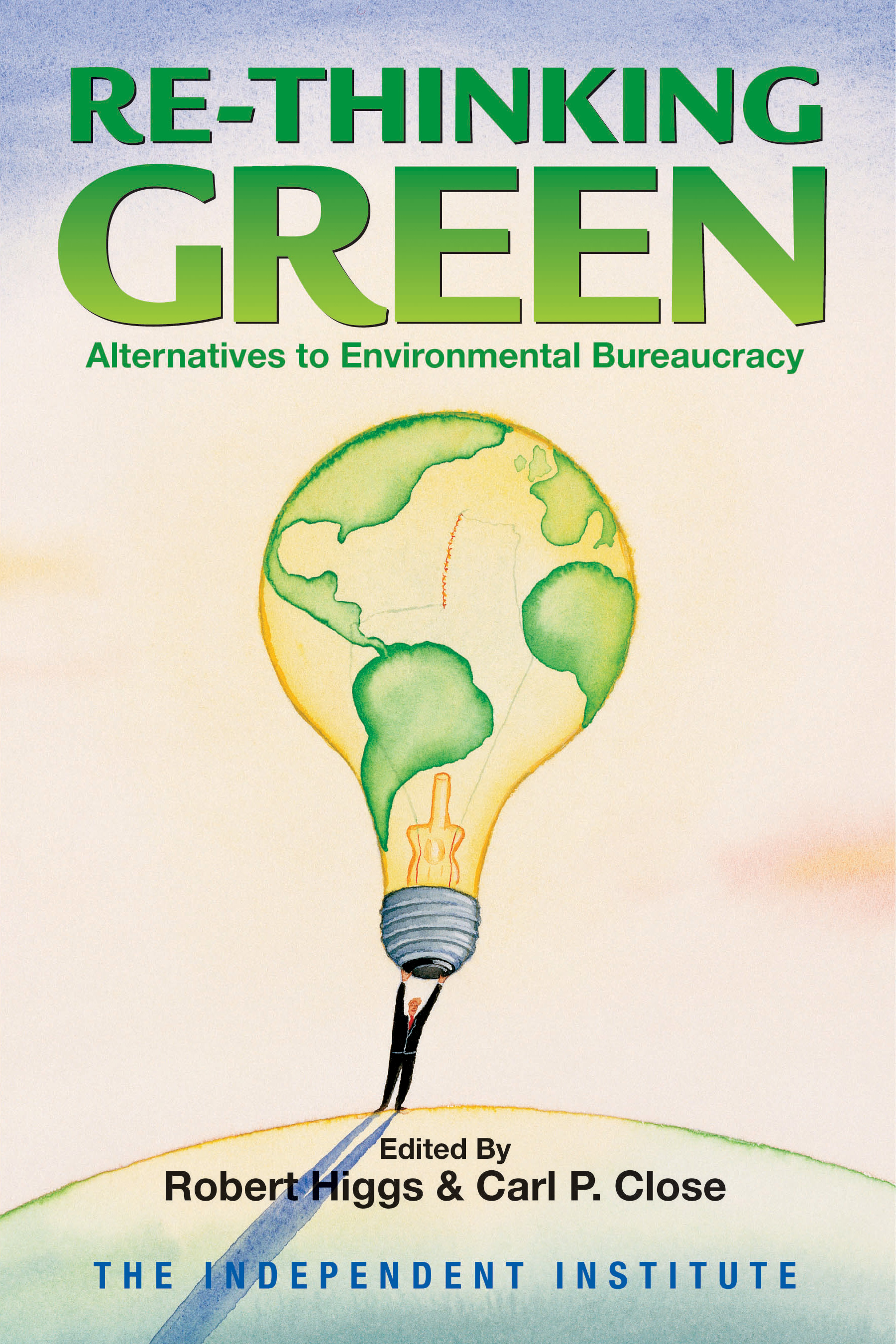
Environmental quality has been a major public concern since the first Earth Day in 1970, yet the maze of environmental laws and regulations enacted since then has fostered huge government bureaucracies better known for waste and failure than for innovation and success.
Can we do better than this failed environmental bureaucracy? The noted contributors to this volume answer with a resounding “yes.”
Re-Thinking Green exposes the myths that have contributed to failed environmental policies and proposes bold alternatives that recognize the power of incentives and the limitations of political and regulatory processes. It addresses some of the most hotly debated environmental issues and shows how entrepreneurship and property rights can be utilized to promote environmental quality and economic growth.
Re-Thinking Green will challenge readers with new paradigms for resolving environmental problems, stimulate discussion on how best to “humanize” environmental policy, and inspire policymakers to seek effective alternatives to environmental bureaucracy.
Contents
Chapter 1 Introduction
Robert Higgs and Carl P. Close
Chapter 2 Prophecy de Novo: The Nearly Self-Fulfilling Doomsday Forecast
Craig S. Marxsen
Chapter 3 Doomsday Every Day: Sustainable Economics, Sustainable Tyranny
Jacqueline R. Kasun
Chapter 4 Population Growth: Disaster or Blessing?
Peter T. Bauer
Chapter 5 After Kyoto: A Global Scramble for Advantage
Bruce Yandle
Chapter 6 Global Warming and Its Dangers
J. R. Clark and Dwight R. Lee
Chapter 7 The Endangered Species Act: Who’s Saving What?
Randy T. Simmons
Chapter 8 Fixing the Endangered Species Act
Randy T. Simmons
Chapter 9 Environmental Colonialism: “Saving” Africa from Africans
Robert H. Nelson
Chapter 10 The Ivory Bandwagon: International Transmission of Interest-Group Politics
William H. Kaempfer and Anton D. Lowenberg
Chapter 11 Free Riders and Collective Action Revisited
Richard L. Stroup
Chapter 12 Entrepreneurship and Coastal Resource Management
James R. Rinehart and Jeffrey J. Pompe
Chapter 13 To Drill or Not to Drill: Let the Environmentalists Decide
Dwight R. Lee
Chapter 14 Externalities, Conflict, and Offshore Lands: Resolution through the Institutions of Private Property
John Brätland
Chapter 15 Is Urban Planning “Creeping Socialism”?
Randal O'Toole
Chapter 16 Eco-Industrial Parks: The Case for Private Planning
Pierre Desrochers
Chapter 17 Regulation by Litigation: Diesel-Engine Emission Control
Bruce Yandle and Andrew P. Morriss
Chapter 18 The Environmental Propaganda Agency
Craig S. Marxsen
Chapter 19 Market-Based Environmentalism and the Free Market: They’re Not the Same
Roy E. Cordato
Chapter 20: Market-Based Environmentalism and the Free Market: Substitutes or Complements?
Peter J. Hill
Chapter 21: Does “Existence Value” Exist? Environmental Economics Encroaches on Religion
Robert H. Nelson
Chapter 22: Autonomy and Automobility
Loren E. Lomasky
Index
Detailed Summary
- By 1990, 25 years of regulations enforced by the EPA had cost the U.S. economy an estimated 22% of the manufacturing output that otherwise would have been produced. The regulations’ drag on productivity was felt strongly throughout the U.S. economy until the mid-90s boom in high-tech industries less touched by environmental policy. (ch. 2)
- Entrenched businesses often support regulations for reasons of competitive strategy. Shell Oil and British Petroleum may have reversed their opposition to the Kyoto treaty because they believed that their natural gas and coal deposits would allow them to cope with the treaty’s restrictions more effectively than could their rivals. (ch. 5)
- Federal and state agencies spent $529 million per year on endangered-species protection during the 1990s, but they haven’t come close to saving every threatened species in the U.S. as required by law. The Endangered Species Act fails to establish priorities for species recovery and antagonizes property owners instead of rewarding them for conservation. (ch. 7, 8)
- In parts of Africa, community-based natural resource management is challenging the “environmental colonialism” of Western organizations. This approach has reduced black-market poaching and improved living standards by enabling locals to benefit from the presence of wildlife. (ch. 9, 10)
- Private developers on South Carolina’s coastal barrier islands are protecting sensitive shorelines more effectively than had the government. Property-rights approaches to conservation show great promise for protecting offshore resources and other sensitive habitat. (ch. 12–14)
- Increasing urban density often increases traffic congestion. Doubling density reduces driving per capita by 10-30%, not the more than 50% needed to reduce congestion. Portland, Oregon’s “smart growth” plan is predicted to triple the amount of traffic congestion and to increase air pollution and housing prices. (ch. 15)
- Congress has passed several laws to rein in overzealous federal regulators, including the Unfunded Mandates Reform Act of 1995, the Regulatory Flexibility Act of 1980, and the Congressional Review Act of 1996. In response, the EPA has adopted an aggressive strategy of “regulation by litigation.” This led to the heavy-duty diesel engine industry’s having to pay a $1 billion settlement even though it had complied with air-pollution regulations. (ch. 17)
Environmental quality has been a major public concern since the first Earth Day in 1970, yet the maze of environmental laws and regulations enacted since then has fostered huge government bureaucracies better known for waste and failure than for innovation and success.
In Re-Thinking Green: Alternatives to Environmental Bureaucracy, twenty-two economists, political scientists, and philosophers show how environmental quality can be enhanced more effectively by relying less on government agencies that are increasingly politicized and unaccountable and more on environmental entrepreneurship and the strict enforcement of private-property rights.
Many of our current environmental policies have been highly ineffective, costly, and harmful to our liberal legal and political traditions, argue the book’s editors, Robert Higgs and Carl P. Close, in chapter 1. Unless we are mindful of the incentives and constraints of the political process—and reform our public policies accordingly—the problem of government failure in environmental policy will continue, they explain.
Part 1: The Seeds of Environmental Bureaucracy
Environmental bureaucracy has been fertilized by the idea that unless humankind reduces its consumption of natural resources dramatically and quickly, cataclysmic environmental disasters will precipitate a global depression and threaten our health and well-being on a massive scale. In chapter 2 Craig Marxsen argues that economic growth slowed significantly during the two decades following the publication of The Limits to Growth (1972)—but not because of the worldwide environmental calamity that book predicted. Rather, the book created a crisis mentality that led to the enactment of ill-considered regulations that have hampered productivity throughout the U.S. economy.
“Sustainable development” is the fashionable but nebulous term associated with proposals to deal with “limits to growth.” Although using the term acts to signal one’s ostensibly progressive worldview, some sustainable-development theorists have advocated in its name proposals that would eviscerate our liberal political traditions, such as mandatory birth licenses, the abolition of private land ownership, and the forced resettlement of human populations in order to “re-wild” parts of the planet, as Jacqueline Kasun shows in chapter 3.
Part 2: Global Issues
Population growth, especially in the developing world, has also spawned worries that have fed environmental bureaucracy. In chapter 4 the late Peter T. Bauer challenges the assumption that population growth necessarily retards economic progress. It is people’s conduct, not their numbers, that causes poverty or prosperity, according to Bauer. Environmentalists and humanitarians should worry more about government policies, not poor people’s procreation, which is often associated with rising standards of living, he argues.
Global warming is now considered by many to be the most troubling consequence of population growth and industrial development. In chapter 5 Bruce Yandle discusses a little-known aspect of the global-warming debate—support for the Kyoto Accord by companies that would benefit relative to their competitors from greenhouse-gas restrictions. In chapter 6 J. R. Clark and Dwight R. Lee argue that market-based tools (e.g., tradable emissions permits) would likely mitigate any serious harms that may be caused by global warming and do so more efficiently than Kyoto-style restrictions.
Part 3: Endangered Species
Endangered-species protection is a popular goal, but existing policies have fallen far short of their mark. In chapter 7 Randy T. Simmons argues that perverse incentives and lack of prioritization undermine efforts to protect threatened species in the United States. He discusses promising strategies, such as giving property owners an interest in protecting sensitive habitat, in chapter 8.
Robert H. Nelson explains in chapter 9 how both biodiversity and native African traditions have been disturbed by the imposition of Western conservation strategies. Such counterproductive strategies also led to the 1989 international ivory-trade ban. Conservationists predicted correctly that the treaty would hasten the African elephant’s demise, but a small group of activists was still able to generate broad-based public support for the ban, as William H. Kaempfer and Anton D. Lowenberg explain in chapter 10.
Part 4: Entrepreneurship, Property Rights, and Land Use
The “tragedy of the commons” arises when common-property users have weak incentives to economize on resource consumption. A similar problem arises when too many citizens assume that others will monitor government programs effectively. The resulting weak oversight allows special-interest groups to manipulate bureaucracies to their advantage, often to the detriment of environmental quality, as Richard L. Stroup explains in chapter 11.
Where private-property rights are well-defined and strongly enforced, market entrepreneurs can provide environmental goods and services. In chapter 12 James R. Rinehart and Jeffrey J. Pompe show how private developers have protected sensitive shorelines. Private-property rights to sensitive habitat can also be granted to environmental groups, who would then have strong incentives to balance conservation with development, as Dwight R. Lee explains in chapter 13. In chapter 14 John Brätland shows how private-property rights can resolve both environmental externalities (e.g., offshore oil leaks and spills) and political externalities (e.g., the shifting of costs by special-interest groups onto taxpayers).
Part 5: Urban Environments
“Smart growth” is a set of urban-planning policies that includes reducing suburban sprawl by subsidizing high-density urban living. In the case of Portland, Oregon, high-density policies have raised housing costs and increased traffic congestion and pollution-failures reminiscent of central planning in the Soviet era, according to Randal O’Toole in chapter 15. In chapter 16, Pierre Desrochers examines privately planned eco-industrial parks (e.g., that of Kalundborg, Denmark) and finds that government planners can do little to improve upon them other than simply to remove regulatory barriers to resource recovery.
Part 6: By-products of Environmental Bureaucracy
Environmental bureaucrats have adopted creative means to expand their regulatory reach. The EPA’s billion-dollar legal settlement with heavy-duty diesel engine manufacturers illustrates that one new tool—regulation by litigation—appears to be incompatible with the agency’s mandate to improve environmental quality, argue Bruce Yandle and Andrew P. Morriss in chapter 17. Environmental protection isn’t advanced when agencies exaggerate their successes and obscure their failures, but the EPA has repeatedly distorted its performance in implementing the Clean Air Act, Craig Marxsen argues in chapter 18.
Part 7: Debating Market-Based Environmentalism
In chapters 19 and 20, Roy E. Cordato and P. J. Hill debate the merits of excise taxes, tradable permits, and other market-based tools intended to help rationalize environmental policy. Cordato argues that because such tools are designed to help regulators meet government-chosen goals, they fall far short of a truly market-based approach to environmental policy, which would rely on price signals, the enforcement of private-property rights, and the common law of trespass and nuisance. Hill replies that despite their obvious reliance on government goals, “market-based” policies that utilize incentives would bring us closer to adopting a genuine private-property rights approach.
Part 8: Environmental Philosophy
Re-Thinking Green concludes with critiques of two philosophical doctrines that promote environmental bureaucracy. In chapter 21 philosopher Loren Lomasky defends the automobile against the charge that it fosters social alienation and explains eloquently how cars help individuals direct the course of their own lives.
Finally, “existence value” (the theoretical value attached to knowing that wildlife and wilderness exist somewhere in a pristine condition, unspoiled by man) is scrutinized by Robert H. Nelson in chapter 22. Nelson argues that despite its scientific veneer, this concept is highly problematic and is rooted in a fundamentalist environmental theology.
Praise
“To the growing literature and debate on environmental governance Re-Thinking Green adds important insights about alternatives to centralized government control. . . . The book makes good on the editors’ claim that Public Choice theory ‘contributes positive insights that can promote the improvement of our institutions’. The authors featured herein effectively marry Public Choice theories’ pessimistic stance on big government with the rigorous application of economic concepts to produce a well-written and interesting collection of ideas and arguments.”
—The Canadian Geographer
“In Re-Thinking Green, Higgs and Close present a remarkable book that should send the green bureaucracy to their collective battle stations. The book clearly shows the shortcomings of the status quo in which government agencies advance a power agenda that far more reinforces their ambition to expand their controlling turf than produce cost-effective, market-based solutions to assorted environmental problems.”
—Robert C. Balling, Jr., Professor of Geography, Arizona State University
“Is the human race irrevocably headed for disaster? With ever increasing population and finite energy and other natural resources, are we truly 'spaceship earth' per R. Buckminster Fuller's vision, or are such thoughts fundamentally flawed? Can development be sustainable? If global warming and climate change are at issue, are regulations the answer or will market forces independently effect change? Is the traditional approach to managing endangered species effective? Does 'smart growth' enhance the urban environment or cause more congestion and air pollution? Are market-based solutions a viable alternative to command-and-control environmental regulations? These and other questions are examined in Re-Thinking Green.”
—Natural Resources and & Environment
“Re-Thinking Green is quite relevant for the following reason. These days all kinds of environmental groups and activists are competing with each other to produce highly scary and doomsday scenarios about ever increasing threats from all kinds of either real or imagined natural hazards. While the approach is not scientific, this book presents the facts from a socio-economic point of view and makes some very rational recommendations and suggestions. For this reason, this book is of general interest and I recommend it.”
—Natural Hazards
“This superb book provides provocative, fresh insights into the debate over appropriate public policy regarding the environment.”
—Gary D. Libecap, Donald Bren Distinguished Professor, Bren School of Environmental Science and Management, University of California, Santa Barbara
“Re-Thinking Green challenges the reader to consider whether the existing approach to environmental regulation has been effective and if some other strategy may be better suited to achieve environmental protection goals. . . . very interesting.”
—Journal of Environmental Quality
“Re-Thinking Green is a splendid book that is very adaptable for teaching. The book is clearly written and interesting, covers the environmental topics that concern us today, and features good science and economic logic.”
—Roger E. Meiners, Professor of Economics, University of Texas at Arlington
“Forces readers to re-think both the accomplishments of environmental policy and the policy strategies that will be most effective. The diverse policy studies in this book illustrate how government regulations often generate unintended results.”
—W. Kip Viscusi, Professor of Law and Economics, Harvard University
“We would all benefit if arguments like those presented in Re-Thinking Green were taken seriously by environmentalists and the general public.”
—Daniel Chirot, Professor of Sociology, University of Washington
"For those who still feel the exhilaration of the 1970s, when environmentalism became a creed and new federal legislation its liturgy, Re-Thinking Green might seem the work of the devil. But this isn't a malicious devil, merely devilish—teasing, insightful, provocative, and occasionally even fun. The essays chosen by this book's two editors, scholars at the libertarian-leaning Independent Institute, will sometimes make you angry. But they will also make you take a fresh look at some of the environmental dogma that has come to be taken as gospel.”
—Environmental History
“A complete guide to environmental policy. This book provides a history of erroneous environmental thinking, a devastating critique of current policies and a menu for improvement.”
—Paul H. Rubin, Professor of Economics and Law, Emory University
“Re-Thinking Green is an important and timely book. It shows clearly the connection between bad science and bad environmental policies that neither help the environment nor are consistent with basic American values. Just as wars bring bureaucratic intrusions on our lives, misguided notions of imminent eco-disasters are used to justify an environmental bureaucracy that can abrogate basic rights of property and due process. The authors in this book show how counterproductive this kind of approach has been and how much better the environment would be served by different policies that rely more on market forces than bureaucratic rules. Those whose primary commitment is to a better environment rather than a hostility to the marketplace are especially advised to read this book."
—Sam Peltzman, Ralph & Dorothy Keller Distinguished Service. Professor of Economics, University of Chicago
“Environmental economics is an important topic in today's world. . . . Re-Thinking Green is a collection of articles analyzing a number of environmental issues from a neoclassical economic perspective. . . . The authors principally rely on a market-based, pro-capitalist approach that views limited government as the answer to solving environmental problems. They focus on the idea that increased government regulations have hampered economic growth and at the same time decreased environmental protection. . . . It is consistently argued that the cost of protecting the environment is often not well justified or scientifically proven, and when justified financially, its benefits are often inaccurately over-represented. . . . The book is valuable in that it outlines clearly the neoclassical view of environmental regulation, which is presently driving the creation of many environmental policies in the government. It is important to understand these arguments.”
—Review of Social Economy
“Re-Thinking Green is an excellent book of easy-reading essays dealing with environmental policy from the perspective of ‘free-market environmentalism’ which combines ideas of public choice theory and Austrian economics. . . . The economic arguments and empirical observations presented in the book remove the readers’ ‘rose-colored glasses’ regarding government action and force them to think about alternative solutions. . . . Re-Thinking Green clearly articulates the message that the current focus of environmental policy (i.e., to solve environmental problems through government regulation) is wrong. . . . I would join the opinion of Roger Meiners on the back cover and strongly recommend Re-Thinking Green for classroom use.”
—Quarterly Journal of Austrian Economics
Author
Robert Higgs is Senior Fellow in Political Economy at The Independent Institute, author of Against Leviathan and Crisis and Leviathan, and editor of the scholarly quarterly journal, The Independent Review.
Carl Close is the Academic Affairs Director of the Independent Institute in Oakland, Calif. and assistant editor of The Independent Review: A Journal of Political Economy.